

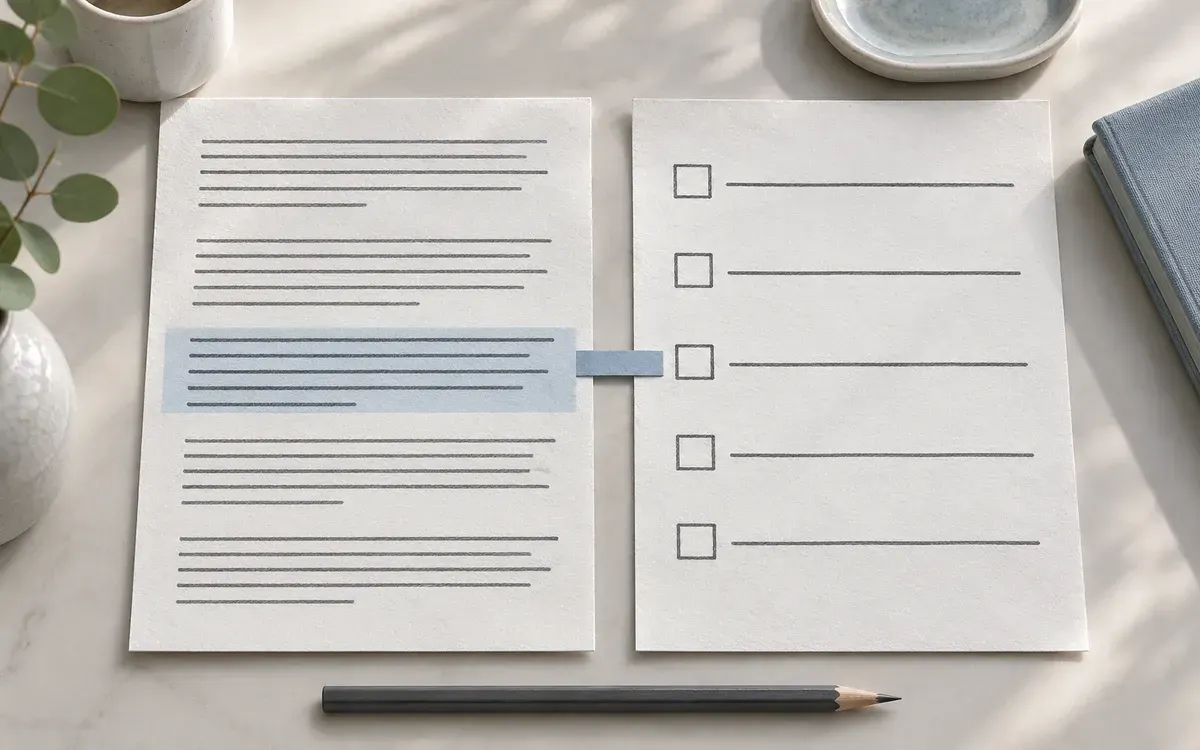
Give ChatGPT the current procedure and ask for a checklist that keeps every required action, condition, and exception, with a source location beside each item. Compare the draft with the original before anyone uses it. I’d keep the first version as a plain document: it’s easier to catch an invented approval or a missing stop condition before the checklist enters a shared workflow.
Start with one approved procedure
Choose the procedure that governs the task, including its title, version, owner, and scope. A checklist made from an obsolete copy can preserve the wrong instructions perfectly. If two documents conflict, ask the process owner which applies before combining them.
Use an account and workspace approved for the material. Remove secrets, personal details, and unrelated internal information before pasting. OpenAI’s data-control guidance distinguishes model-training settings from other data settings and workspace policies; changing one setting doesn’t establish permission to share a company procedure.
This route starts with readable text. Copy the relevant procedure into a working document, keep the original wording, and give its paragraphs or steps stable labels such as S1, S2, and S3. Include prerequisites, warnings, notes, and exceptions that change the task. Don’t paste only the numbered steps if the conditions sit in a paragraph above them.
For medical, safety-critical, legal, or regulated work, keep the organization’s approved checklist and review process in control. Use AI to propose a transcription or restructuring for the responsible expert to review. A general chatbot’s output doesn’t establish that a procedure meets a law or standard.
Request actions with source locations
Open a ChatGPT conversation and paste your request and labeled source into the message field. You can do this without connecting a task manager or giving the assistant permission to change documents. OpenAI’s prompting guidance recommends clear instructions, enough context, and revision after reviewing the response.

Ask for one independently completable action per item. Keep the source’s order where one action depends on another, and keep an if, unless, before, or after beside the action it qualifies. “Check the file and send it” needs two items if checking and sending can fail separately.
Convert the procedure below into a reusable checklist draft.
Use only this source for requirements. Do not add best practices,
approvals, deadlines, owners, thresholds, tools, or missing steps.
Do not send messages, create tasks, or change external records.

Source title/version: [title and approved version]
Scope and intended user: [what this procedure covers]

First, identify conflicts or missing information that prevents a
usable checklist. Ask questions rather than silently resolving it.
Then draft a numbered list. For each item include:
- action and the condition under which it applies;
- stated owner, or "not specified";
- stated completion check/evidence, or "not specified";
- source label plus a short exact supporting quotation.

Preserve prerequisites, order, warnings, AND/OR conditions,
exceptions, and stop/escalation instructions. Split independently
completable actions without changing their dependencies.
Leave all completion states blank. Do not imply work is done.
Put possible improvements in a separate review list, never among
source-backed requirements. If the source can't be read, stop.

PROCEDURE START
[S1... Paste approved procedure text here.]
PROCEDURE END
The request sets a review method; it can’t guarantee compliance with the instructions. OpenAI warns that confident answers and citations can still be wrong. Check the quoted passage yourself rather than accepting a source label as proof.
Keep the branch that changes what happens next
Here’s a constructed office example. The wording below is the complete source for the exercise, not a company policy or a record of work performed.
S1. Before sharing the weekly status sheet, the coordinator checks that the reporting period matches the requested week.
S2. If any row lacks an owner, the coordinator holds the sheet and asks the team lead to supply the missing owner. Share the sheet only after all owner fields are complete.
S3. The coordinator shares the sheet in the agreed team channel and records the message link in the tracker.
A useful checklist draft from that source would look like this. The items below describe future checks; they aren’t evidence that any check has passed.
- Check the reporting period. Coordinator: compare the sheet’s period with the requested week before sharing. Completion check: the periods match. Source: S1, “checks that the reporting period matches the requested week.”
- Check every row for an owner. Coordinator: verify that no owner field is empty before sharing. Completion check: all owner fields are complete. Source: S2, “Share the sheet only after all owner fields are complete.”
- If an owner is missing, hold the sheet. Coordinator: do not proceed to sharing while the condition remains unresolved. Completion check: sharing remains on hold; recorded proof of the hold is not specified. Source: S2, “holds the sheet.” If no owner is missing, mark this conditional item not applicable and record that reason.
- If an owner is missing, request it from the team lead. Coordinator: ask for the missing owner, then recheck item 2 before sharing. Request evidence is not specified. Source: S2, “asks the team lead to supply the missing owner.” A request alone doesn’t establish that the field is now complete.
- Share in the agreed team channel. Coordinator: proceed only when the reporting period matches and all owner fields are complete. Completion evidence: the message in that channel. Sources: S1–S3; S3 says “shares the sheet in the agreed team channel.”
- Record the message link in the tracker. Coordinator: save the link for the shared sheet. Completion check: the tracker contains that message link. Source: S3, “records the message link in the tracker.”
The source doesn’t name the channel, identify the tracker, set a response deadline, or prescribe a record of the request. Leave those questions for the process owner. I wouldn’t add “manager approval within 24 hours” to make the checklist feel complete: neither requirement exists in this source.
The hold in item 3 is a condition that remains active, not a task that permanently passes when first ticked. If an owner is removed later, the sharing condition fails again. Keep that dependency visible when moving the list into another format.
Keep a provenance and disposition record
Give every checklist item a small evidence record: source label, exact supporting wording, condition, owner as stated or “not specified,” completion evidence as stated or “not specified,” and current disposition. Use accept when the source supports the item, ask when a missing detail blocks a usable checklist, and separate proposal for an improvement that needs owner approval. A blank result means nobody has performed the procedure; it is not a hidden pass.
Review the records at the same revision as the source procedure. If S2 changes from “if any row lacks an owner” to “if any required row lacks an owner,” reopen the affected condition and every dependent sharing step. Keep the previous checklist tied to its old version so a completed run cannot be mistaken for evidence against the new rule.
Audit the draft in both directions
Read from the procedure to the checklist first. For each source requirement, find the corresponding item. Check that qualifications survived: “A or B” mustn’t become “A and B,” an optional action mustn’t become mandatory, and a warning mustn’t move after the step it governs.
Then read from the checklist back to the procedure. Find support for every action, owner, limit, deadline, and claimed completion check. Remove an unsupported requirement or put it in a clearly separate proposal for the process owner. A plausible suggestion still needs approval before it becomes part of the procedure.
You can ask ChatGPT for a second review in the same conversation:
Audit the checklist against the supplied procedure.
For each source label, list the requirements and where the draft
covers them. Flag omissions or changed conditions.
Then inspect every checklist item for unsupported additions.
Check order, prerequisites, AND/OR logic, exceptions, stop conditions,
owners, deadlines, and completion evidence.
Quote the source for each issue. Do not rewrite the checklist yet.
If no issue is found, still show the source-to-item mapping.
Verify that review against the original too. Another AI answer doesn’t independently certify the first one. Where an item says “check that this is correct,” name the observable result or ask the process owner to supply it. EvalCommunity Academy’s verification-criterion tutorial explains why a check needs an observable pass condition and evidence. Its sample thresholds are examples, not numbers to import into your procedure.
If the material instead records decisions from one meeting, use the meeting-notes action-list workflow. That task needs agreement on assignments and dates; it isn’t a reusable procedure merely because the output is a list.
Save a blank template and review one normal and exception path
Have the process owner resolve the open questions and review the revised checklist. Keep proposed improvements separate until approved. Walk through the normal route and each relevant exception against the procedure; where practical, have an intended user try the approved draft under the organization’s normal supervision. Resolve any point where the user has to guess.
Save the reviewed template outside the chat with its source title/version, scope, checklist version, and owner. Give each check an empty result field and room for the evidence the approved process requires. Keep a completed run as a separate record so the next person starts with blank fields. “Not applicable” should include the condition that made the item inapplicable; it mustn’t hide a failed check.
A document checklist doesn’t enforce its branches. If you later move it into workflow software, check that platform’s actual condition and review behavior before enabling automation. For example, Unifize distinguishes reviewed AI suggestions from Auto-fill, which writes values directly and can overwrite a prior value when rerun. Keep a source-backed draft separate from permission to update a live record.
When the procedure changes, compare the changed source passages with the affected checklist items, review their dependencies, and issue an approved new template. Keep past run records tied to the version they used. Your next step is to resolve the draft’s source gaps with the process owner, then save the blank reviewed version where the people doing the task can find it.